(Before I even get started this week, this title is a joke and will mean very little to anyone not familiar with skateboarding.)
I’m 49 and made the questionable decision last summer to take up skateboarding for the first time since I was 16. More than anything, it was an excuse to hang out with some writer friends that made a similarly questionable choice as well. We’re 7 months in and I think I have sprained and/or strained *everything* twice, and I still feel physically better than anytime in the last 15 years or so. It has been sketchy, but great exercise.
The title of this post is a joke because skaters, despite the false stereotypes as dirty delinquents, have come up with incredibly detailed and intricate terminology for naming tricks. If you ride with your left foot forward, that is “regular” stance, but if you naturally ride with your right foot forward it is called “goofy” (short for goofy-footed in the old days.) If you are going backwards, that is “fakie.” Jumping and popping with the board into the air off your back foot is an “ollie,” while jumping/popping off your front foot is a “nollie.” If you are rotating as part of your trick, if you turn your front toward the obstacle that is “frontside,” whereas turning your back toward an obstacle is “backside.” Then there are shuvits, heel and kick flips, tre flips, hardflips, laser flips, etc. I could go on for paragraphs. Then on top of all that, as different tricks get combined, the names stack up, almost like Germans forming their compound words, so someone may ride backwards up to a curb and do a “Fakie frontside 180 Feeble to backside tailslide to bigspin out.” (If you aren’t among the best in the world, that actual trick would actually be ridiculous. I just used it as an example.)
Anyway, on to poetry! I bring all this up because a friend and I were at the skatepark last week and debating what to call a certain trick, as there are sometimes multiple names that would explain it. After about a minute I realized I should stop worrying about it and just appreciate how cool it was that I got to watch my friend land that trick! I laughed to myself because I’ve been having these same thoughts about language in general, especially in the case of poetry.
Language is symbolic. Literally every word is a symbol. If we hear (or read) the word “tricycle,” it conjures up the image of a child’s 3-wheel bike. For me, the image is specifically a red tricycle with little plastic pedals. We give meaning to every word through context, repeated usage, and mutual agreement over time. BUT, the word itself is not a thing, not an action, not a description! In the most base, experiential way, we experience simply hearing a sound. . . or viewing a series of ink squiggles. Much of John Cage’s work (among many others) was often aimed at making this point. His famous piece, 4’22, is not at all about silence as many people think. It is about framing a section of time for the audience in a way that they can experience whatever incidental sounds happen with an open and appreciative, inquisitive ear.
Similarly, my experiences with Zen Buddhism suggest that we get so attached to the meaning of symbols (words, signs, etc) that it is often difficult for us to let go and simply experience them without immediately creating an idea about that sound or visual symbol beyond the experience of it. I think this is why many great artists of the mid-to-late 20th century were/are particularly attracted to Buddhism. This includes Cage, Kerouac, Ginsberg, Clark Coolidge, Anne Waldman, and Herbie Hancock just to name a few offhand.
I recently read Bruce Andrews’ Paradise & Method: Poetics & Praxis and he opened with a quote collage. I won’t recreate it in its entirety here as it is almost 3 pages long, but I thought it really spoke to this point and was a perfect way to begin the book, so here are just a few of the quotes:
- A sound, a rhythm, a name, an image, a dream, a gesture, a picture, an action, a silence: any or all of these can function as ‘keys’ – Jerome Rothenberg
- Distinguish between that ‘old’ music. . . which has to do with conceptions and their communication, and this new music, which has to do with perception and the arousing of it in us. – John Cage
- Each word is a syntax, a sensory object – more than descriptions, vehicles, or emotional journalism: sound, texture, weight, targets, rhythms, sight, presence. – Bruce Andrews
- An object is whatever it becomes under the impulse of the situation at hand. – Rothenberg
- I look at it as an event, not as a descriptive instance. – Aram Saroyan
- The poem is not a signboard, pointing to a content ultimately to be regarded; but is, on the contrary, a form inhabited by intelligence and feeling. Content = when words are yoked together and draw attention away from themselves and are aimed at a commonly-referred-to outside world. – Andrews
- Henry Cowell once remarked that Cage and his circle were composers who were ‘getting rid of glue’. What he meant, according to Cage, was that where people had felt a necessity to stick sounds together to make a continuity, Cage and his friends felt the opposite necessity to get rid of the glue so that sounds would be themselves.
- A sentence fades with its owner; the words continue to go their own way. – Clark Coolidge
- Meaning is not importantly referential. – Robert Creeley
- A message takes attention from words. – Andrews
This point is something I feel very strongly about as an artist and human who appreciates art. When we get too caught up in telling (or looking for) a story, sometimes we miss the experience itself.
I’m about to drop some strongly opinionated writing here, so I want to genuinely preface it by saying that we all have different tastes, likes/dislikes, experiences, etc and that is what makes art beautiful! I may really dislike a certain poem, or piece of music, or sculpture, but it may be someone else’s favorite. I absolutely love that about art, and the world would be a boring place if it were at all different where we all shared the same opinions about art. I actually enjoy art I don’t enjoy. The fact that I experience it is the act of being alive! Even if I don’t like a piece of art there is a LOT to be learned from it as a creative person. In the end, it is really cool that someone took the time to create something and share it with others. It is ok to have opinions about those things, and I’ve sometimes got strong ones, but just remember that a human is still attempting to be creative and share it. Whether it is my (or your) cup of tea, it is magical. Similarly, I don’t expect people to like what I create. If they do, awesome! But, I tend to explore pretty experimental territory as an artist. I definitely direct my study that way. It isn’t for everyone and that is fine. We can all be a happily creative community, be friends and colleagues and still have opinions. It is human nature, the beautiful thing about art, and a way we can learn from one another as we continue to grow and explore creativity.
Okay, so that said. . . I, generally speaking, usually have a strong distaste for what I call “journal entry poetry.” I’m talking about poems that go on and on about someone’s personally angsty experience in an attempt to get us, as listeners, to feel something. Save time and just gag me.
For some background context, as a trained musician who studied a lot of Western (aka European classical) music, we went through several periods in music from the Renaissance to Baroque to Classical eras, then finally the Romantic era of the mid-late 1800s prior to 20th Century music. The Romantic composers in particular composed some just beautiful emotionally charged pieces. Beethoven’s Sonata Pathetique, Chopin’s Nocturnes, Mahler’s symphonies (especially the Adagietto of Mahler’s 5th Symphony which I encourage everyone to listen to. I think it is the most beautiful thing every written. Leonard Bernstein loved this piece so much he was buried with a copy of the score.)
While the exact dates and names for various periods in art change from music history to visual art history to literature, there is a lot of similarity in goal and expression from period to period. The paintings of the late 1800s were equally moving in the stories they told.
Now here’s the thing. . . That was over a hundred years ago. Chopin and Mahler, Winslow Homer and Edgar Degas, Lord Byron and Yeats were all geniuses, and they created some of the pinnacles of Western art, works of beauty in the sophisticated languages of their respective arts at the time.
They are dead.
Stop chasing their ghosts. Really.
There was a time and place for these works of art that were the height of emotion, story-telling, and expression. They are still amazing, but we don’t need to make sad attempts at rehashing it. The world and the arts have moved on and I remained unconvinced that any of us can or will top the Romantic work of those past geniuses in a century-old language. So, when I hear “journal entry poetry,” I often think that a simple therapy appointment would be a more appropriate use of the writer’s time. When I see or hear an artist trying to create something in a hundred-fifty year old style, I genuinely wonder if they’ve taken the time to find out what has happened in the world of the arts in the last 80 years or so.
Now, I know that is a strong opinion and I probably contradict myself on this from day to day anyway, BUT. . . I’m still fine listening to 99% of poetry, seeing the paintings, hearing the songs because it isn’t my cup of tea but it may be someone else’s favorite thing ever. That, again, is the wonderful thing about art!
I am often delighted by the absolutely chaotically surreal. I talk to friends often about how we can hear poems read that have no intentional meaning and our brains still try to glue things together, to make some sort of narrative. It is natural, and getting back to my original point, it is a result of having brains that are used to using functional language as signs/symbols to communicate.
When I am confronted by something so chaotic or strange that my brain doesn’t know what to make of it, that is often the most fascinating art experience I can have! When we can let go of meaning, let go of the glue of yoked together words, and experience sound as sound, that is the most honest, true, experience we can have, shed of the illusions of thought and meaning. Again, this is the part where artists and Zen Buddhism intersect, but I’m not here to preach about that in that way.
One of the areas of poetry I’ve been studying and working on is “Sound Poetry” where it isn’t about language or telling a story anymore. We use the voice to create a sound experience beyond language for the listener. The ironic part is, as a sound poet, I find myself creating a personal language of sounds and techniques over time that find their way back into future pieces. Still, it is about letting go of meaning.
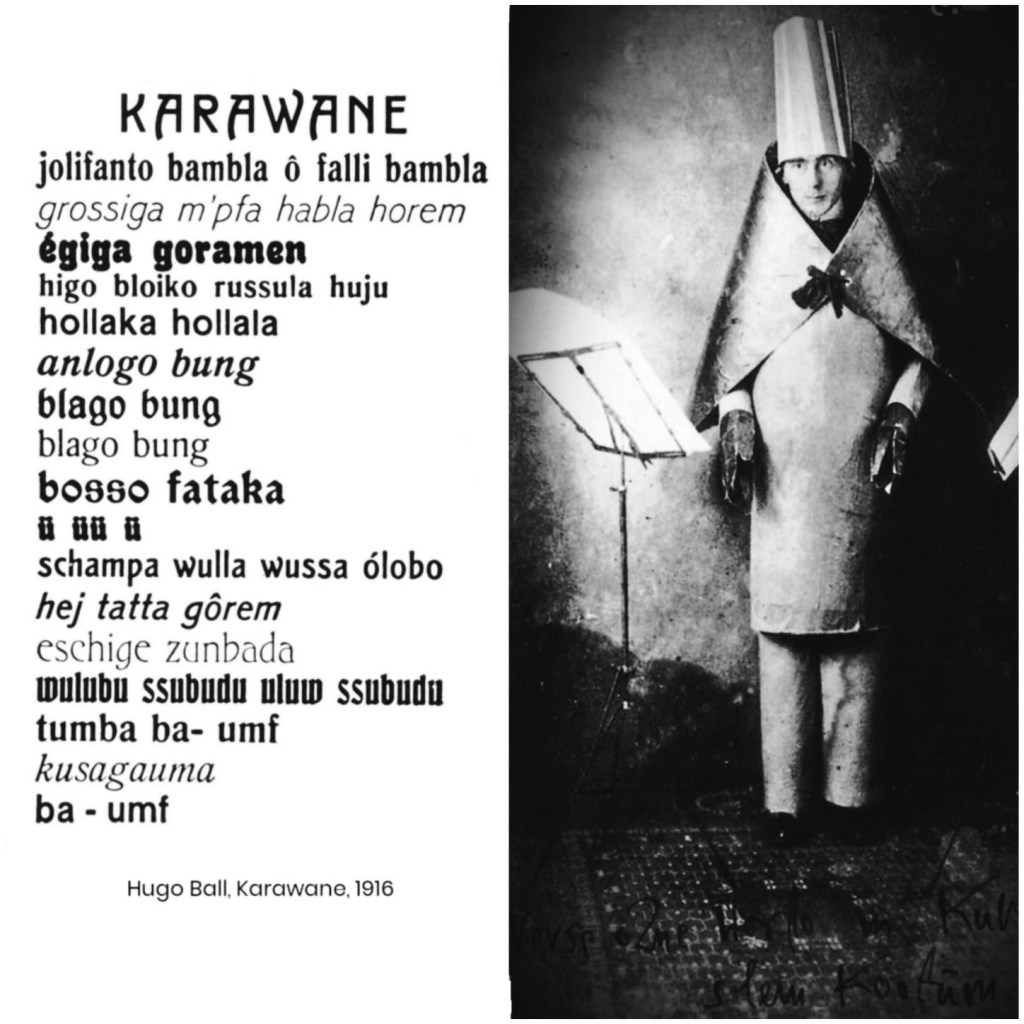
One piece I wrote last year was a single phrase repeated somewhere around 8-16 times, followed by the repetition of two other very similar phrases. If you sit and repeat a word over and over and over and over it begins to lose all meaning.
My first experience with this was when I was probably 5 or 6 years old. Our family used to take weeklong trips to Minocqua for fishing and general family vacationing. My dad would take my brother or I out in the boat to fish. I remember sitting in the boat humming along to the pitch of the outboard motor which was quite loud. Eventually I started, for whatever reason, repeating the word, “Again.” Again Again Again Again
Again
Again
Again
Again
Again
Again
Again
Again
Again
Again
Again
Again
Again
Again
Again
Again
Again
Again
Again
Again
Again
Again
Again
Again
After a couple minutes, I realized I couldn’t remember what the actual word was or what it meant. It had become simply a repeated sound. (I suppose I stumbled on Mantra chanting practice accidentally.)
Fast forward 43 years. The piece I wrote begins:
From lamplight
to lamplight
to lamplight
to lamplight
to lamplight
to lamplight
to lamplight
to lamplight
to lamplight
to lamplight
to lamplight
to lamplight
to lamplight
to lamplight
to lamplight
to lamplight
to red room
to red room
to red room
to red room
to red room
to red room
to red room
to red room
to red room
to red room
to red room
to red room
to pillow down
to pillow down
to pillow down
to pillow down
to pillow down
to pillow down
to pillow down
to pillow down
to lamplight
to lamplight
…
etc.
(note: if you take the time to read the above excerpt aloud, it is a very different experience than just reading it silently from the screen/page.)
The experience of this over multiple minutes, I have been told, becomes quite meditative. The words become sounds and the sounds have a pumping effect. I feel like this is probably a very brute force way of bringing the listener to a place of experiencing the sound of poetry over the “glue” of yoked together words, but it worked.
My hope is that listeners can take experiences like this and bring those ears to other poetry as well, both as a listener and writer. When I write things closer to traditional poetry, I still very much consider the sound of the words I am choosing. As Bruce Andrews said, they have weight, rhythm, texture, and *targets*!
I’ve heard quite a few poems and open mics that could have been meandering TED talks or simply short stories. That’s fine. You want to write a short story? Go for it! You want to take your 5 minutes to tell me about that walk you took in New York last time you were there? Cool! But if we’re going to frame things as poetry, it is my hope that writers/performers consider the weight and rhythm of their words. What is the texture of the next phrase you are going to say? Not in terms of meaning, but does the sound of that word have an intent, a direction, a target? How does that sound resolve into the next sound? Is there a way we can place the words we are using to create a sonic experience beyond the story?
The definition I use with my students for music is:
“Music is organized sound.” As simple as that.
The example I give them is:
- If the wind blows a pair of garbage cans down the street, that is not music. It might be a really interesting sound, but it isn’t music.
- If I roll a pair of garbage cans down the street, NOW it is music! It may not be good music, but that is up to the listener. The organization and intent is there. We have framed it and created something through our organization.
I hope that poets think about their writing this way. Next time you’re going to write, pick a word. Repeat it to yourself for a minute or two. Let it roll around in your mouth. . . and your ear. How does that sound feel? What other sounds suggest themselves? NOW we’ve got the beginning of something new!!!
…
And, next time you’re at the skatepark, don’t worry about whether that person across the room did a ‘tre-flip’ or a ‘laser flip’. Just appreciate how cool it is to experience it!
Jay Mollerskov, ArtRoot Writer-in-Residence –2/9/26
 ArtRoot Writer-In-Residence
My mentor often spoke of the musicality of poetry. Your performances remind me to look for rhythms, variations, and emotion!
LikeLiked by 1 person
As I mentioned somewhere in this post, “Music is organized Sound.” I suppose poetry technically fits the definition, but at the same time I feel like it is somehow belittling to lump poetry under the banner of music. It is its own thing(s) for sure.
That said, we as poets should always keep open ears to the rhythms, direction, etc of the sound of the material we work with.
My point in the post wasn’t to take away from the telling of stories or meaning held within poetry, but more just to keep in mind the yarns we are using to weave, so to speak.
LikeLike