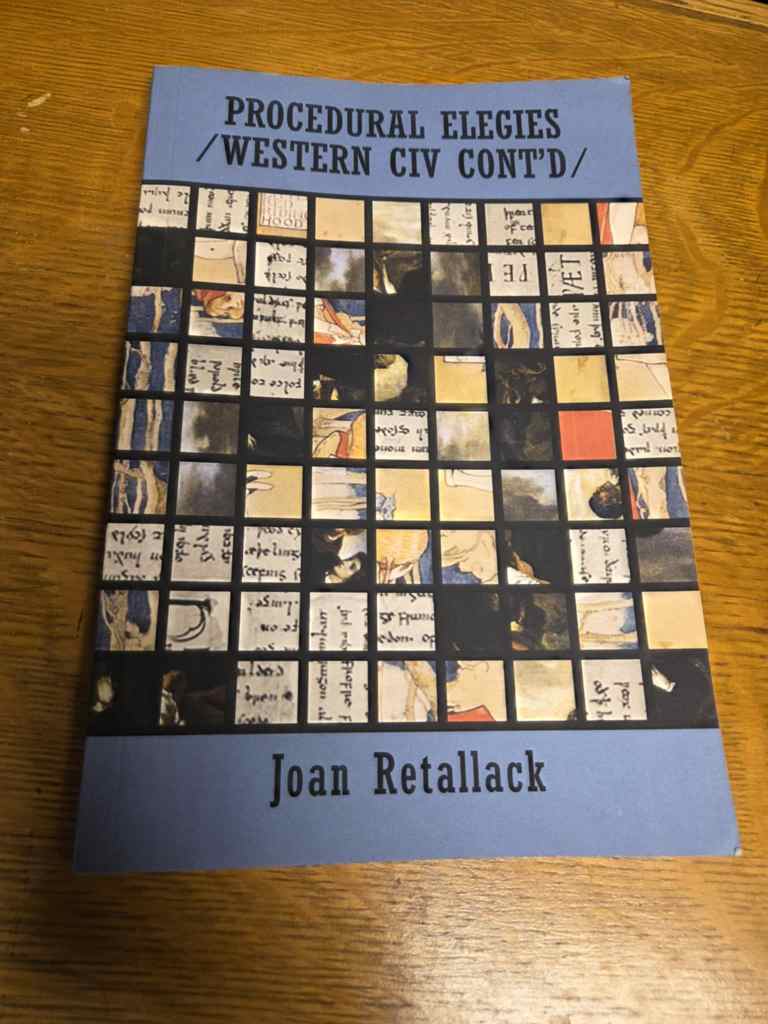
As promised, this week I’m going to take a look at a poem that was, in part, generated through procedural means. This poem, A I D /I/ S A P P E A R A N C E, by Joan Retallack first appeared in Object 5 in 1995, then was later included in her book “PROCEDURAL ELEGIES/WESTERN CIV CONT’D/”. I find this book quite interesting, and a big departure from traditional poetry. If you are curious about some of the experimental directions modern poetry has taken, I recommend this book as a great example by a modern master of writing.
The poem is as follows:
A I D /I/ S A P P E A R A N C E
for Stefan Fitterman
for Stefan Fitterman
1. in contrast with the demand of continuity in the customary description
2. of nature the indivisibility of the quantum of action requires an essential
3. element of discontinuity especially apparent through the discussion of the
4. nature of light she said it’s so odd to be dying and laughed still it’s early
5. late the beauty of nature as the moon waxes turns to terror when it wanes
6. or during eclipse or when changing seasons change making certain things
7. disappear and there is no place to stand on and strangely we’re glad
A I D S
for tefn Fttermn
1. n contrt wth the emn of contnuty n the cutomry ecrpton
2. of nture the nvblty of the quntum of cton requre n eentl
3. element of contnuty epeclly pprent through the cuon of the
4. nture of lght he t o o t be yng n lughe tll t erly
5. lte the beuty of nture the moon wxe turn to terror when t wne
6. or urng eclpe or when chngng eon chnge mkng certn thng
7. pper n there no plce to tn on n trngely we’re gl
B H J C E R T
fo fn Fmn
1. n on w mn of onnuy n uomy pon
2. of nu nvly of qunum of on qu n nl
3. lmn of onnuy plly ppn oug uon of
4. nu of lg o o yng n lug ll ly
5. l uy of nu moon wx un o o wn wn
6. o ung lp o wn ngng on ng mkng n ng
7. pp n no pl o n on n ngly w gl
F G K Q U
o n mn
1. no n w m no on ny no my pon
2. o n nvly o nm o on n nl
3. lm no onny plly pp no on o
4. no l o o yn nl ll ly
5. l y o n moon wx no own wn
6. o n l pow n n no n n mn n n
7. pp n no pl o no n n nly w l
L P V
o n mn
1. no n w m no on ny no my on
2. o n ny o nm o on n n
3. m no onny y no on o
4. no o o y n n y
5. y o n moon wx no own wn
6. o now n n no n n mn n n
7. n no o no n n n y w
M O W
n
1. n n n n n y n y n
2. n n y n n n n
3. n n n y y n n
4. n y n n y
5. y n n x n n n
6. n n n n n n n n n
7. n n n n n n y
N X
1. y y
2. y
3. y y
4. y y
5. y
6.
7. y
Y
1.
2.
3.
4.
5.
6.
7.
Each repetition of the original stanza goes through a permutation based on some rules. In the 2nd stanza, the wood/letters AIDS is a header. Then, the the body of text is repeated, but with all the A, I, D, and S letters removed.
In the 3rd stanza, the header is: B H J C E R T. These letters were chosen because they are the letters that surround A, I, D, and S in the alphabet. These letters are then removed from this repetition of the text.
The 4th stanza begins with F G K Q U. These are the letters that surround the previous header letters (B H J C E R T), minus any that have been used already. This process continues until we are left with only Ys, then finally the Ys are removed and no text remains.
A I D S -> B H J C E R T -> F G K Q U -> L P V -> M O W -> N X -> Y
Ok, so Retallack made these “rules” and played out the procedure, generating some unintelligible stanzas of text that get smaller and smaller until nothing is left. Big deal, right? But. . . why? I would argue that we don’t even need a why, but in this case there is one. It is symbolic, and it is, in many ways, the heart and point of the entire poem.
A hint to the story of this poem lies in the dedication to Stefan Fitterman. Fitterman was an award winning theater director, and he died of AIDS in August of 1993. This entire poem is about the AIDS epidemic in the 1980s and early 90s. The text starts with the header “AIDS”, then those letters spread to the ones around it, each iteration being removed and spreading until we are left with an empty body of text.
There are millions of poems out there that tell stories. The story in this poem lies in the procedure itself. I personally find that fascinating and, to be honest, more moving and haunting than most. Without telling the story via the words themselves, A I D /I/ S A P P E A R A N C E plays out the loss of lives to the AIDS epidemic through the removal of letters and text.
I’ll quickly point out that this isn’t a poem I would try to read aloud. Some poems are beautiful on the page, but lose their meaning or direction completely when read aloud. Some poetry is great when spoken, but it falls flat when read to one’s self off the page. The written and spoken-word traditions often intersect, but they also sometimes have two very different directions. The more I’ve dug into sound poetry, the more this distinction has become apparent, and I’m sure I’ll get more into that in future weeks! I find beauty, variety, and interest in both of these parts of poetry though.
In a past post I wrote about using algorithmic or procedural means as a starting place, the use of self-imposed limits to provide a framework in which to begin work. This example is the flipside of that idea. At the recent Woodland Pattern Poetry Marathon, a young student prefaced his reading by talking bout how everyone has days where they aren’t inspired and how it was just fine to wait until the next inspiration strikes. I wholeheartedly continue to disagree with this! Anyone who has worked creatively has probably experienced what we, these days, describe as a Flow State. Sometimes it is easier than others to get into that flow state and output creative work, but we can use all sorts of methods to begin work or simply continue to practice regardless.
With that said, I’ll close with a quote:
“Inspiration exists, but it has to find you working.” – Pablo Picasso
Jay Mollerskov, ArtRoot Writer-in-Residence –2/2/26


Thank you for bringing us these thoughts and inspirations. I agree. The news lately keeps knocking me right out of the flow state. But I move back into it. Without flow my tears become an ocean that overwhelms.
LikeLike