Racine public transit director Trevor Jung faces challenges to keep Racine public transit ridership headed toward growth
In his first two years as Director of Transportation and Mobility for the City of Racine, Trevor Jung has worked in tandem with Mayor Mason’s Paris Climate Accord pledge by increasing bike, scooter and pedestrian accessibility, while he’s also brought savings to the bus system by electrifying the fleet and introducing other cost saving measures.
With a personal history that fuels his passion for public service, Jung sees his momentum of accomplishments — but he recognizes he must navigate a tight course to continue to improve service following the rebrand of city transit from the Belle Urban System to RYDE Racine.
From Russia, With Love
Adopted at a young age after his birth in Russia, Trevor Jung readily talks about his journey to Racine as a narrow escape from poverty.
Jung grew up with a sense of gratitude for the city in which he lived — as well as a duty to give back, which he said was instilled by his single, gay father. That sense of responsibility led him to pursue urban planning studies at UW-Milwaukee, where he decided that involvement in local government offered the greatest opportunity to make an impact.
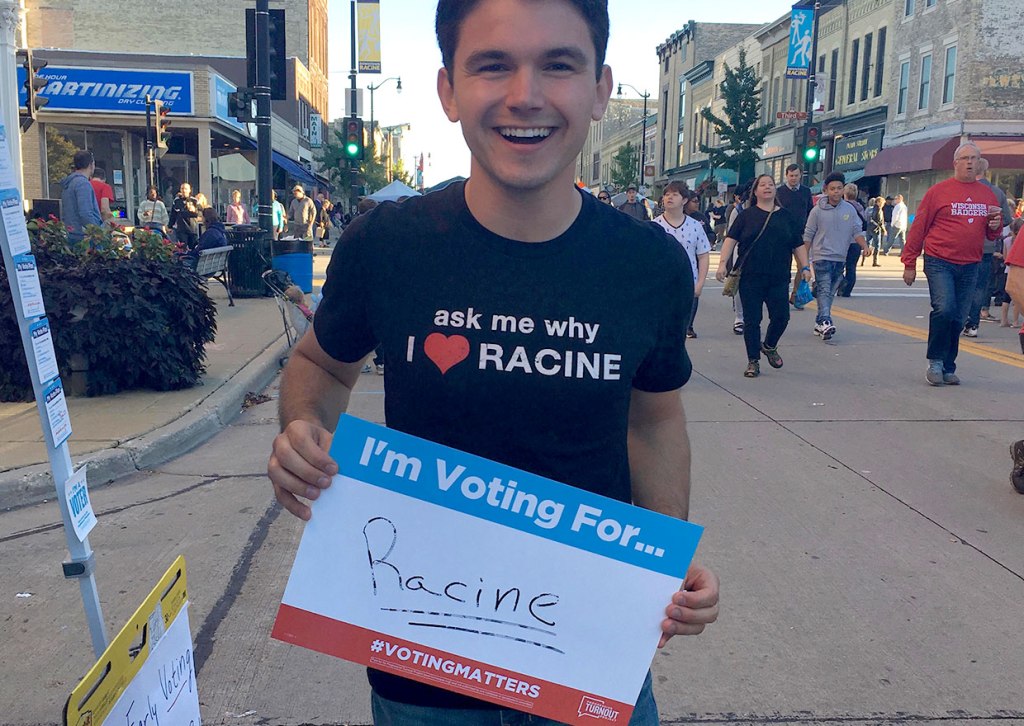
His target? Transforming Racine’s approach to public transportation gives Racine a position to leverage for sustainable growth in the Chicago-Milwaukee corridor, which Jung quickly points out comes in as the country’s third largest economic region.
But not without the right infrastructure to keep all ships afloat while the tide rises.
City overhauls transit policies in effort to escape isolation
“Transit policy to date had isolated Racine,” Jung said.
But perhaps his biggest accomplishments so far consist in transforming the sustainability of RYDE bus and paratransit services as well as access for a number of vulnerable populations … all while steadily boosting the post-COVID ridership numbers.
Jung, who stepped down from his two-term stint as alderman for the Ninth District early to take on the directorship under Mayor Corey Mason, smiles when he mentions the savings and sustainability he has brought to Racine’s bus fleet, which also recently got a new website.
But he’s proudest of the increase in ridership over recent years, and he’s looking to grow further. After the pandemic, ridership has increased 30% over the past two years.
One of the first steps he made to revolutionize Racine’s bus system was to cut out the private management that had been bloating the budget and have the city manage the transit system payroll directly.
“That created some efficiencies,” Jung said. “And the private sector partner was no longer interested in continuing the relationship because of union related issues.”
Then, utilizing federal funds, Jung worked to make 25% of the 35 fleet electric in 2022, and he has eyes on increasing that to 40% by next year.
Plus, by adding solar panels to the bus garage soon, the RYDE will be better able to absorb the funding cuts to transportation that have eroded public transit service and access to date.

Savings means absorbing cuts while keeping public transit affordable
Jung points out that with the progressive decreases in public transportation funding in recent decades, the offsets he’s been able to bring to the RYDE system have absorbed cuts more than in resulted in direct savings.
Some savings have been passed on to vulnerable populations, though. At $2 per day for unlimited rides, public transit definitely offers a cost-saving alternative for some local drivers. Reduced 30-day passes that require proof of senior citizenship or an ADA or Medicaid card lowers cost to $1 per ride.
And a variety of riders pay no fare at all. Children under 5 and veterans ride free, as do students at Gateway Technical College who take advantage of the free monthly pass provided by the college’s new partnership with the city.. And RUSD students who live within 2 miles of their school can catch a ride at no cost, too.
Though it’s a far cry from the frequency of the historic Union Pacific (formerly Chicago Northwestern system), the city’s partnership with Coach USA KRM commuter bus line runs seven times daily during the week on a route that makes direct connections between Kenosha, Racine and Milwaukee, with a stop at the Metra station in Kenosha that ends in Chicago. On Saturdays, the route runs six times, and on Sundays, there are four.
Obstacles remain for regional transit
But Jung admits that problems remain with the bus system.
Pre-COVID, the bus had been serving on average more than 1,000,000 unique rides per year, so even the increase post-pandemic represents a net drop in ridership.
Take for instance that for the most affordable option for bus ridership. A monthly pass at $65 costs $5 more than riders would spend on daily fares in even the seven 31-day months.
And then there’s the limitations of routes running just twice an hour or only at peak times, while many routes’ stops still leave considerable distance to go for many riders’ final destinations, complicating timely arrival at jobs or appointments.
When outlying villages and townships decide not to kick in funding to extend Racine’s routes to their businesses, companies can’t access the workforce they need to operate, and many city residents lose access to jobs that would keep food on the table.
Many bus riders complain about the frequency of routes, with many bus lines running hourly at off-peak hours during the week or on the weekends. And the KRM commuter bus’ latest run during the week arrives at the Metra Station to meet the 7:32 train arriving from Chicago, but the last train from the city comes into Kenosha at 12:14 a.m.
Regional transit survey change route frequency, coverage and fares
Jung emphasized that increasing ridership is one of his main priorities.
Regional transit operations like Milwaukee County Transit conduct regular regional transit audits. Racine County could conduct a similar audit to assess priorities and gauge public opinion.
Jung said that in the face of lower operating budgets, modern public transit has to choose between frequency and coverage. While Racine’s ten-route system is built around a coverage model that provides service to more destinations, an increase in frequency wouldn’t be off the table.
And he floated the idea of introducing a capped-fare system that would give riders a reusable card to track spending and provide more economical alternatives.
“There’s a lot of really cool things we’re doing with savings and sustainability,” Jung said, “But at the end of the day it really is about service. What can we do to get people on the bus to get them where they need to go?”
The next installment in this feature looks at one rider’s observations about the difficulties they’ve faced in navigating Racine’s bus system.
 ArtRoot Writer-In-Residence
Thanks for educating me about our bus system.
LikeLike