One of the subcategories of poetry that I’ve found myself, as a longtime musician and composer, drawn to is Sound Poetry. In some ways, while I’ve only been writing for just under 2 years, I’ve been thinking about sound poetry a lot longer. I’ve written before about my definition of music being “organized sound,” and Sound Poetry definitely occupies a middle ground between poetry/literature and music.
Rather than a focus on the words, sound poetry is about using vocal sounds (including words sometimes) to create a piece of sonic art. I have found this to be a fascinating territory to explore because many of my musical tendencies and a lot of my training and practice as a composer still applies, but working with words and the voice has been new territory rather than instrumental music.
Some local people have heard me perform sound poetry pieces, but I know in many cases that was some of their only exposure to it. My friend and mentor, Steve Timm, is another poet who improvises sound poetry pieces here in Wisconsin. I think it is safe to say Steve and I have very different styles. As a matter of fact, the more I explore the history of sound poetry and listen to recordings, the more I think every sound poet has their own unique style.
Rather than write on and on about it, I think a better introduction is to simply provide links to several examples here and let the readers/listeners hear and learn for themselves!
The first piece I discovered is also one of the earliest written sound poems of which I’ve found a recording. This piece, ‘Hunger Strike’ by Jackson Mac Low was written in 1938, but recorded here in 1980: https://recitalprogram.bandcamp.com/track/jackson-mac-low-hunger-strike-wh-a-t-does-lifemean
This recording was from the 12th Annual International Sound Poetry Festival. Here is a link to the entire album recording of the festival. https://recitalprogram.bandcamp.com/album/the-12th-annual-international-sound-poetry-festival
Whereas Mac Low’s Hunger Strike is based around words or sounds from parts of words, another performance from the same festival highlights how syllables can be used in a very rhythmic way for a totally different effect. This is Carles Santos performing “To-Ca-Ti-Co-To-Ca-T”. https://recitalprogram.bandcamp.com/track/carles-santos-to-ca-ti-co-to-ca-t
Another, more contemporary piece, which also focuses largely on rhythm but in a much less regular way is a favorite of mine, “Africa(n)” by Tracy Morris:
https://youtu.be/RfFOetu5U7M?si=wGqaA9UPmgG4MiJn
This piece was inspired by DJs scratching, sampling, making breakbeats, etc, which she discusses in the introduction in the video above.
The territory between music and poetry gets even more blurred in some pieces from this next album. Writers/musicians like Charles Amirkhanian and John Cage had feet in both worlds of music and art as they produced work. Some of these pieces utilized tape loops or other electronic processing.
Here is Amirkhanian’s “Just” https://othermindsrecords.bandcamp.com/track/just
And the complete album, with pieces by Cage and others as well: https://othermindsrecords.bandcamp.com/album/10-2-12-american-text-sound-pieces
Then there are/were also group performances. The Four Horseman was a particularly well known Canadian quartet in sound poetry circles in the early 80s. Here is a clip of them performing, from the documentary, “Poetry in Motion”:
I would be remiss if I didn’t include the following video of Madison poet, Steve Timm, recorded by our friend Nick Demske in Racine, WI.
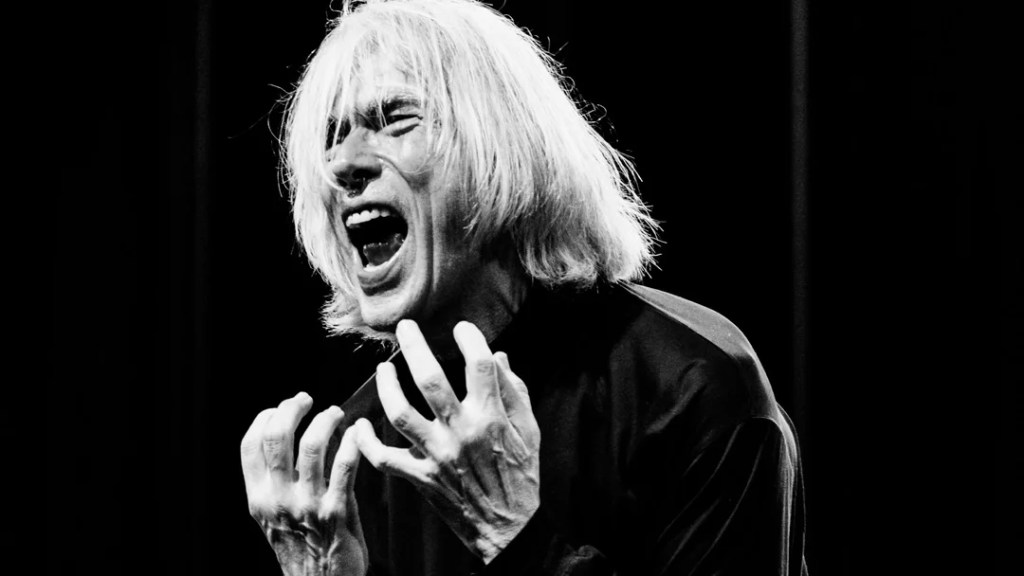
Probably one of the most well known sound poets is Jaap Blonk. Here is a video of him in live performance as well.
Finally, coming full circle back to using actual words, I would count Gertrude Stein’s “If I Told Him” as sound poetry as well, as it draws attention to the sounds themselves over the meaning of them.
Hopefully these examples help fill in at least some points here and there in the broad landscape of sound poetry for those curious to learn/experience more.
As always, I hope you all have a great week, and I’ll be back again soon with another post. (whether it is the next one or not, I don’t know, but I do intend to make at least one post focusing specifically on electronics & sound poetry, and the hybrid pieces created by composers like Steve Reich’s early tape pieces, so look for that down the road!)
-Jay Mollerskov, ArtRoot Writer-In-Residence – 3/13/26
 ArtRoot Writer-In-Residence