Red-lined districts do get service on days, nights and weekends; an upcoming job fair, regional review and voter participation could promote investment in public transit shortcomings
From nine to five,
work along the routes
stays within reach,
but saving the bus
for everyone needs
more eyes and votes
for those left out
of the city's service.
-Nicholas Ravnikar
City of Racine transportation and mobility director Trevor Jung provided evidence to refute criticisms that public transit fails to serve areas of the city that had been subject to red lining.
Acknowledging the limitations of some routes’ evening and weekend availability, Jung said the city is constantly looking for savings solutions to address budgetary constraints and opportunities to improve service.
“It is the deepest commitment of Ryde Racine to make sure that everyone, regardless of neighborhood, has equal access to the transit system,” Jung said. “And no matter your identity, you’ll be treated with dignity and respect and get where you need to go.”
In addition to a September job fair highlighting employers and services along Ryde Racine routes, an upcoming regional transit review that includes public input could inform future improvements, along with voters supporting increased funding.
See also a correction to a previous articles’s inaccurate statement about Ryde Racine fare pricing at the end of this article.
Current transit routes serve red-lined districts
Addressing comments detailed in the last article in this series from former aldermanic and mayoral candidate Dr. Michael Schrader, a transit consultant and professor of transportation engineering, Jung supplied a map of RYDE Racine’s routes overlaid on the map of historically red lined areas of the city of Racine.
While Schrader said that city routes failed to penetrate historically red-lined neighborhoods, Jung’s map shows bus routes running directly through each of the areas. Jung also noted that DART service, which provides individualized transportation to elderly and disabled individuals, serves all areas of the city.
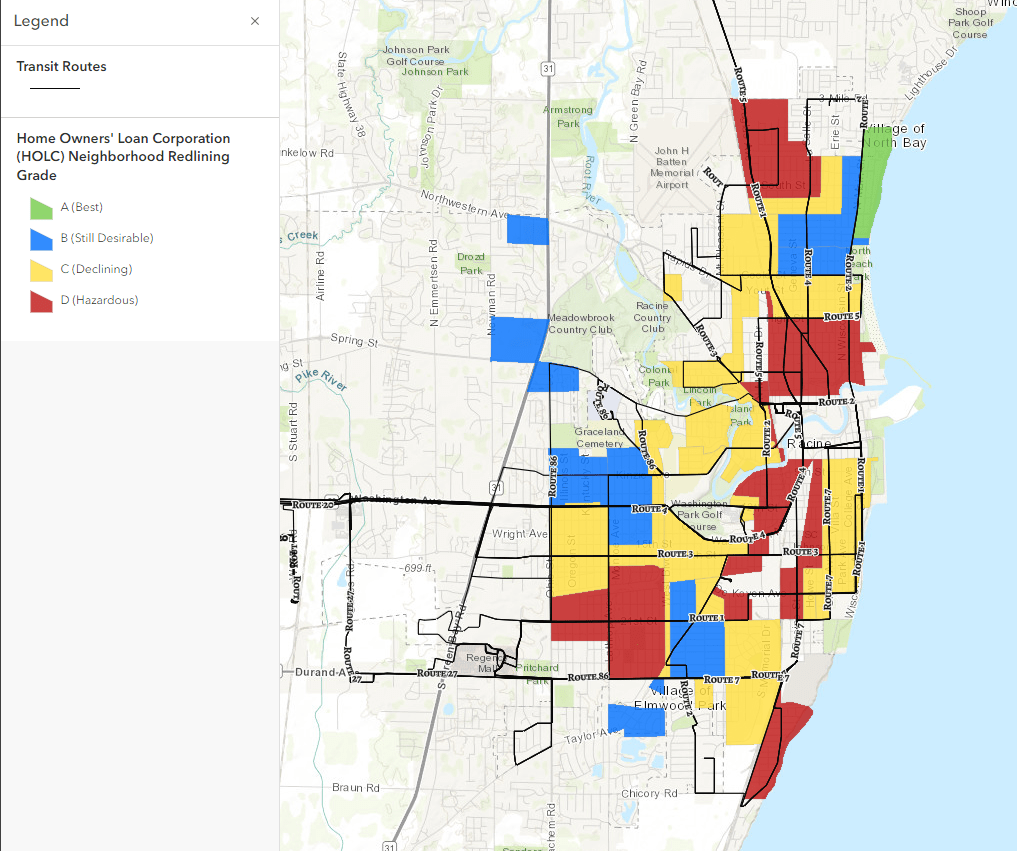
“As you can see, the assertion that ‘very few of the bus routes penetrate the six red line districts of the city’ is incorrect,” Jung said, quoting Schrader’s comment in a previous blog post. The City of Racine and RYDE Racine take the important issues of civil rights and equal access seriously and pride ourselves in this commitment.”
Schrader also expressed concerns about low route frequency, in addition to noting that about half the routes didn’t run on weekends or later than about 7pm. While current prioritization of route service during 9-5 weekday hours is a hangover from a traditional assumption that most work takes place during that time, Jung noted that some routes do run until 11 p.m. and on the weekends through red-lined districts
Jung also noted that Racine public transportation must meet federal mandates overseen by the Transportation Administration’s Division of Civil Rights to serve Racine’s diverse populations equitably.
He also said that his department will expand the current 75 bus shelters among the 700-plus bus stops along all routes to provide more protection for riders during winter. Jung added that his department empowers drivers to choose the best location for dropping off passengers and that safety constitutes one of Ryde Racine’s highest priorities.
However, public sidewalks and curb access represent department of public works concerns, while private walkways remain the jurisdiction of those properties’ owners — business and homeowner alike.
The remaining problems of increasing frequency, Jung said, largely depend on funding. In an ideal world, he would love to have routes run every 15 minutes 24/7.
Given current funding and considering the savings from recent improvements to accessibility, eliminating private payroll management and electrifying, the system is outperforming previous years when it has had an even larger state support.
Transit services face flat state and city investment
The total 2023 budget for public transit amounts to $12.7 million. But Ryde Racine currently receives about 1 million in funding from the city, which represents about the same dollar amount as it received from the city in 2010. And as a percentage of the total city budget, bus service seems to have shrunk.
State funding has also remained flat without adjusting for inflation since 2010, Jung said.
That represents an overall decline in transportation spending power. And while recent federal funding in the form of emergency relief has offset some of the depreciation of state contributions, the federal emergency funds don’t offer a long-term solution.
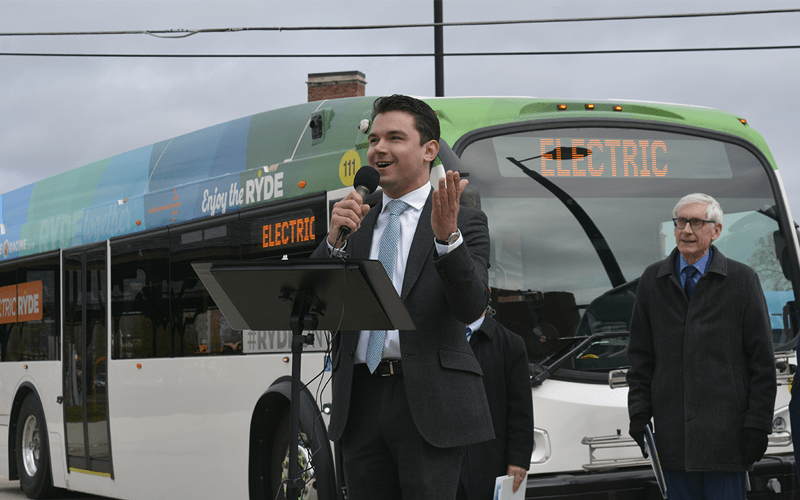
Jung says cost-saving measures that depend on investments in technology can facilitate expanding public transit services to make them more attractive. Electric buses and solar panels to power transit buildings are part of those savings measures.
“Decisions are made around when most people are going to take the transit system based on the information and resources we have,” he said. “Investing in new technologies that result in savings could be a response to expanding service.”
Investing in transit a key part of growth strategy
One means of expanding funding would be increasing ridership. Acknowledging Schrader’s research into commuters selecting private auto over public transportation on the basis of commute time, Jung thinks public transit investment rather than austerity represents the best solution
While Jung agrees that connection to the regional economic centers of Chicago and Milwaukee, he doesn’t see highway expansion as the solution even for long-distance commuters. Investing in public transit will help build a culture around public transit, Jung said, which will contribute to greater density by encouraging more people to live in urban areas served by transportation.
Jung insists that the city remains committed to searching out means to offset expenses, improving service and leverage savings through technology advancements like route tracking, renewable energy, and fare capping.
“Is public transportation evolving as society evolves? Yes.” said Jung. “Yes. Does the transit service need to be nimble? Absolutely. We want to be responsive.”
Jung envisions a future in which the culture of Racine and the surrounding Milwaukee-Chicago metro region embraces technology advances in public transit and commuter rail solutions that could save on expenses. As it stands, because of declining funding, such savings wind up offsetting cuts instead of expanding service.
Public participation can change ridership, funding models and policy
Increasing that budget to expand services depends on overcoming historic policies of austerity at the local, state and federal levels, which in turn requires voter participation and citizen advocacy.
“It comes down to voters participating in their democracy,” he said. “Understanding this is a public service that needs to be invested in asking their elected officials, who have the power of the purse.”
Jung said a regional transit survey by Southeast Wisconsin Regional Transit Commission, which currently offers resources to employers and commuters, will take place next month, September 2023. The commission will gather qualitative data from area residents, and Jung said transit riders and citizens with concerns can voice their concerns either directly to the Commission or directly with him through the Ryde Racine website.
Also slated for September is a collaborative job fair in conjunction with Racine United Way that aims to connect attendees with employers and community resources located along Ryde Racine transit lines. The event, held at Corinne Reid Owens Transit Center (1409 State St., Racine, WI 53404) on Sept. 13 from 4–7 p.m., also features children’s activities so that their adults can network. The event requires no registration.
Correction
The previous article inaccurately stated that because Ryde Racine fares were $2 a day, the $65 monthly pass did not represent a savings. Day passes for Ryde Racine are $4, while a $2 fare gets riders unlimited one-way transfers. Thus the $65 monthly pass represents a 50% savings over a month’s worth of day passes.
Trevor Jung noted that Ryde Racine has plans to explore monthly fare-capping, where regular riders could add up to a certain amount onto a card without having to purchase monthly passes.
 ArtRoot Writer-In-Residence