Complaints about Racine bus service point to causes for historically declining ridership
Amid snowfall and redlines
with access limited
and safety compromised
the vulnerable walk
against traffic
and wait in the cold.

- Nicholas Michael Ravnikar
Born and raised in Racine, Gail M. Eppers has worked in manufacturing most of her life and began to ride the city bus when the fare was just 25 cents. Most of Eppers life followed access to transportation: she moved downtown when the bus hub was on Monument Square, and Eppers chose her house based on its location at the junction of routes 5 and 1 on the city bus line.
A longtime and frequent user of public transit, Eppers expressed both concerns and questions about Racine’s public transit.
As Trevor Jung noted in a previous interview, although unique rides had increased post-pandemic from 2021-2022, that represents a fairly significant decrease from before the pandemic, and the ridership has historically suffered from an overall trend of decrease following successive cuts to dedicated state and federal funding.
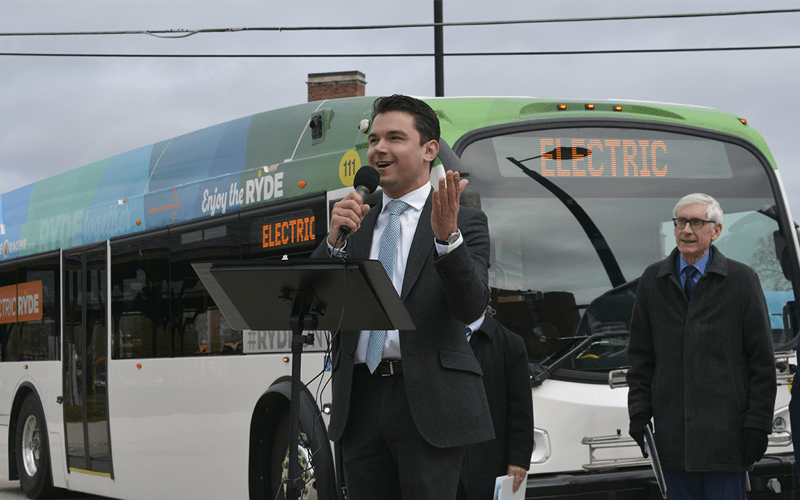
One transportation expert named Michael Schrader, who had run for aldermanic candidate for the Fourth District in 2022 and challenged current Mayor Corey Mason in 2023 as a write-in-candidate, also offered criticism over public transit policy, which he thinks is beyond saving given Racine’s current political regime.
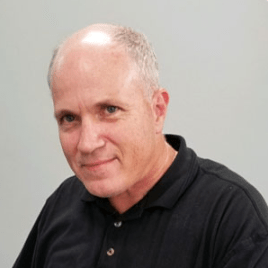
Both of their comments point to the historically declining ridership Trevor Jung acknowledged in the last piece in this series.
Public transit in winter particularly dangerous
Eppers said Wisconsin’s winters are particularly brutal for Racine’s bus riders.
When Eppers worked at InSinkErator, snowfall and unshoveled bus stops or sidewalks made getting from the stop to work very dangerous in winter — especially for the elderly and handicapped.
“In the winter when there is snow cover, some drivers will drop off at the walkway, but others won’t,” Eppers said. “Although it’s a fairly short distance, I’ve had some close calls.”
Requests to the company to extend the shoveled walkway went unheeded, and Eppers noted that “In addition, most corner lot owners don’t bother to clear the areas for crosswalks.
As a result, Eppers has had to climb over snowbanks and walk in traffic.
Timeliness also a main concern for ridership
Safety concerns like this, along with route frequency drive individuals’ choices to take public transportation, according to Schrader.
“Time and safety are what drives mode choice, not anything else,” he said.
Eppers seems to agree.
“I think the long waits make it too inconvenient for a lot of people who might otherwise prefer to save money by riding the bus,” she said. “They’d get more riders if they provided more timely service.”
One reason Racine’s public transit faces an overall decline in public transit ridership may be thanks to what Schrader said is a general consumer tendency to prioritize time in the overall cost of transportation options.
“Time is what drives route choice,” said Schrader, who studied pedestrian accessibility and land use for his 2018 PhD in civil engineering from Detroit’s Wayne State University and has worked as a municipal traffic engineer and a transportation planner before his current positions as a traffic engineering consultant and college instructor of transportation engineering. “And with the exception of NYC, [public] transit is never quicker.”
Eppers has experienced the lag in public transit times first hand.
“If I’m trying to get to an appointment, I sometimes have to arrive an hour early or more because the next bus will make me late,” she said. “I can’t accept some jobs because I simply can’t get there in a reasonable time period. Because of the way the routes are arranged, it can take almost two hours just to get across town depending on the different locations.”
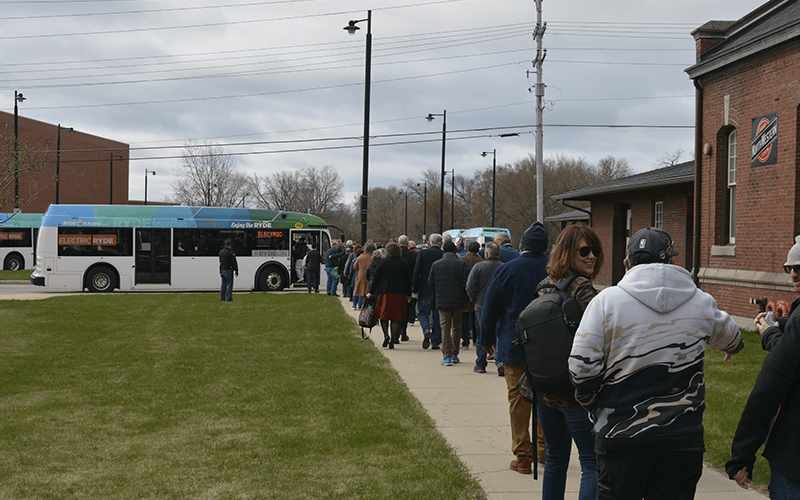
City transit routes avoid neighborhoods still affected by redlining
Public transit needs to prioritize providing access to poor and elderly commuters who lack access to other means of transportation, Schrader added.
“Very few of the bus routes penetrate the six red line districts of the city, and that is where the ridership is,” said Schrader. “They will not get people to abandon cars for buses, but they can sure serve those who need buses a lot better. […] All the [bus] routes are superfluous as they exist right now.”
Redlining refers to a housing industry practice of designating neighborhoods as “dangerous” because of the prevalence of families from “undesirable” racial and ethnic backgrounds. These areas closer to industrial areas with older housing stock within red boundaries that signified
Consequently, potential homeowners often couldn’t get loans for houses in such neighborhoods and were edged out economically for housing in more affluent areas. The historical repercussions include poor access to high quality education, fresh foods, and health care.
“Our districts also happen to be where the worst streets and housing are, as well as too many bars and liquor stores,” Schrader said.
Additionally, while current routes provide service every hour to 30 minutes during the week with some routes running as late as 11:40 p.m., other routes shut down as early as 6:21 p.m. And any that run on the weekend — half do not — stop by about 6:30, far too late for anyone to travel to or from downtown and the lakefront or Racine’s burgeoning uptown arts district to enjoy
Expert: Economic math won’t add up for public transit growth
Schrader says it the decrease in ridership for public transit follows economic logic.
Part of Schrader’s doctoral studies involved examining the three major models that drive transportation engineering.
The gravity model uses socio-economic and time data to predict the number of trips from one point to another, the logit model factors in uses time, age, cost, and other variables to determine what percentage of trips private, public or pedestrian travel, and he California Diversion Equation uses time and distance to determine the travel route.
“Basically, people are willing to go 1/2 further to save a minute in time, which happens to coincide to 30 mph.,” he said. “Very few engineers and planners know this, and don’t really understand the models.
That’s the reason why commuters who can drive their own car do, despite the ecological costs, according to Schrader.
“In the world of modeling, there is a direct correlation between income and trips,” Schrader said. “As income goes up, people take more and longer trips by car, which is why congestion is getting worse despite billions being spent on transit. “
Praise for RYDE Racine on some points of service
Eppers did offer a number of positive points that she appreciates about RYDE Racine.
“A big shout out to the drivers overall for driving in all kinds of weather and in the dark of night,” she said
She noted that all buses are now accessible to wheelchairs, rolling carts, and elderly individuals.
“Most drivers are very patient about slower passengers,” she said.
She also noted that the air conditioning of the bus was comfortable during summer, though she wondered whether summer heat kept some riders away.
“Once you get on, you’re usually very comfortable,” said Eppers. “But a lot of elderly people especially can’t stand there waiting half an hour for a bus in 90+ degree heat. In whether extremes, how many are staying home simply because of that?”
And she had nothing but praise for the RYDE’s handling of pandemic public health precautions.
There were days at work when I was there and people with cars couldn’t make it.
Eppers applauded drivers’ ability to keep routes going during difficult circumstances.
“People tried to get on without masks or would take them off and [one driver] had to keep reminding people of the rules.” Eppers said. “He even had to call the cops a couple of times to take people off the bus, but he kept driving.”
Eppers remains a dedicated public transit user with serious grievances that would seem to impact most ridership.
“I mean, Racine isn’t that big,” Eppers said. “They should be able to do better.”
 ArtRoot Writer-In-Residence
One Comment Add yours