City and county disagree over road names, with 400 feet of indigenous recognition but $30,000 short of more
The first people sent down
from the sky, after treaty
after treaty, received
on ancestral land some
tangled words to remember
a trail of death started
when Spanish boats
and Italian boots reached
Caribbean shores
and stretched forward
toward 400 feet of road
on ancestral land
where restorative justice
comes with a price tag.

- Nicholas Michael Ravnikar
One short stretch of road in Racine, WI stands for a hundreds-year-old struggle between indigenous Potawatomi people, who had resided in the region since at least 1634, and the European imperial impulse.
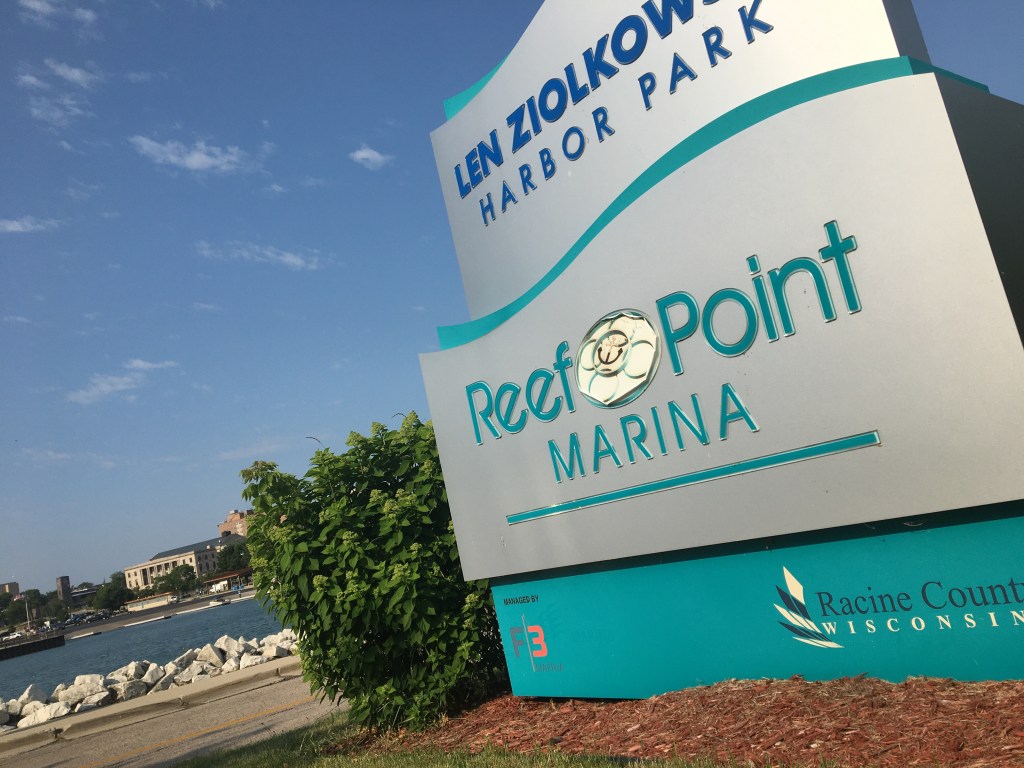
Anyone driving toward Reef Point Marina from downtown might notice how the street sign briefly changes from Kipikawi to Christopher Columbus Causeway.
Shortly after its construction with a combination of city and county funds along with private donations coordinated by Downtown Racine Corporation, the stretch of road connecting Reef Point Marina to downtown Racine was named after Columbus.
Citing both Columbus’ lack of connection to local geography as well as his abhorrent treatment of native people, a group called Coming Together Racine asked the city government to change that name in 2019.
Where Racine’s City Council saw a chance for reconciliation, the parks committee of Racine County government said the $30,000 cost of changing a roadway’s longstanding name is too high.
Petition by local group changes city street name, not county
After a petition by the anti-racism group Coming Together Racine in 2019, the City Common Council quickly passed a resolution renamed the 400-foot-long stretch of causeway near the Reef Point Marina under its jurisdiction from Christopher Columbus to Kipikawi, an approximation of the Potawatomi word for the Root River.
The street sign change, which finally occurred after COVID delays, came with a $500 pricetag.

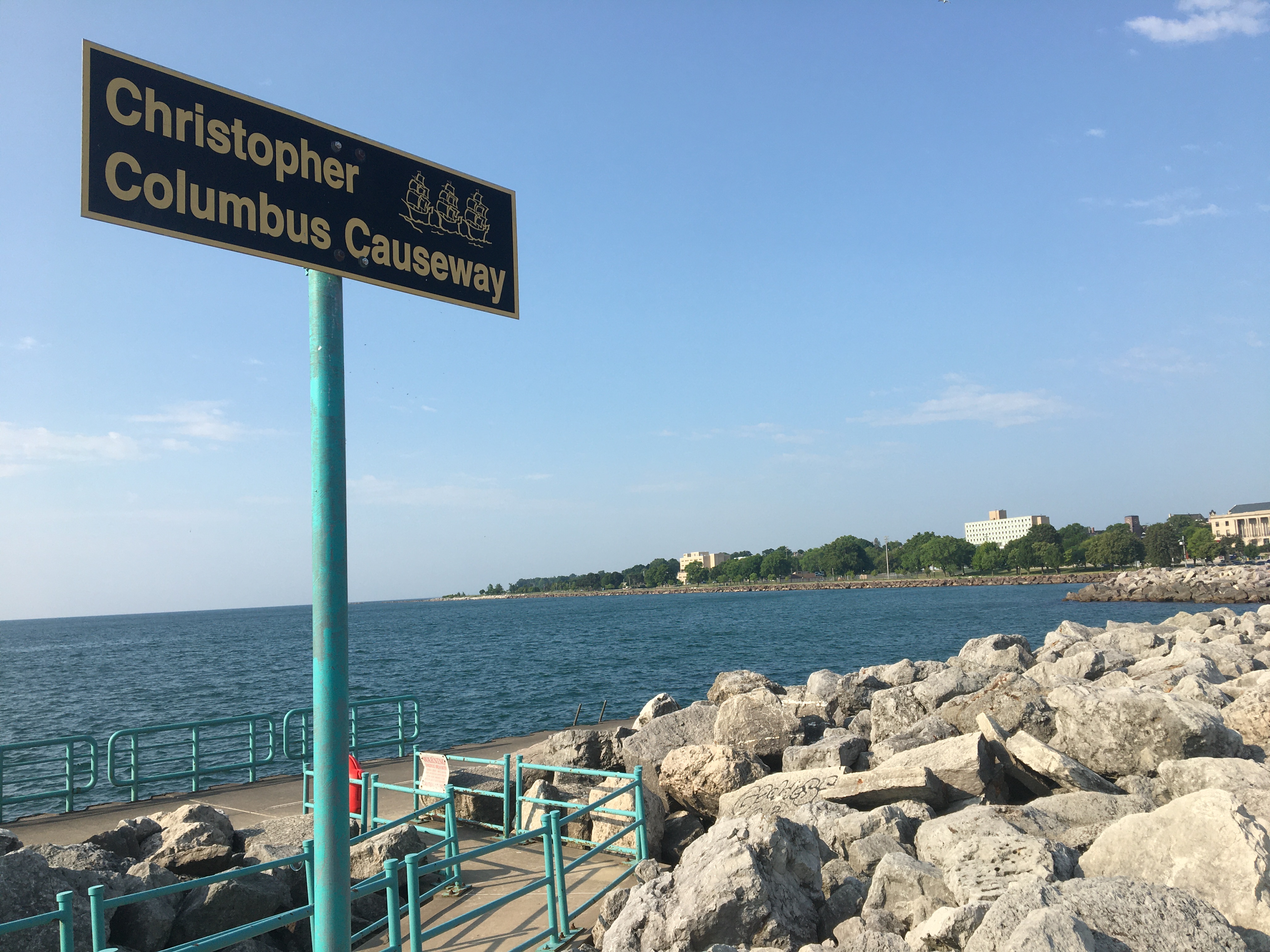
Because Racine County has jurisdiction over the larger part of the road, due to contributing funding toward the construction of the marina and Festival Park developments that border the larger stretch of Christopher Columbus drive, a resolution also went before the Racine County parks commission in 2019, where it was eventually voted down.
“What does Christopher Columbus have to do with Racine in the first place?”
Skip Twardosz, Potawatomi storyteller
“What does Christopher Columbus have to do with Racine in the first place?” Skip Twardosz said. Twardosz is a Potawatomi storyteller who lives in Burlington. Twardosz said that as a traditional word from the Potowatomi, Kipikawi would have referred to the Root River for centuries and even marks the beginning of why French missionaries and explorers would have called the area Racine in the first place. He said he was moved by the decision to change the name, and added that there’s a celebration ceremony each year in honor of it near the end of October
In their argument to city council and to the county board, Coming Together Racine pointed to the practices of torture, enslavement and genocide against native people that followed from Columbus’ arrival in the West Indies, as well as the fact that Columbus never set foot on soil that would become the United States, except for one stop in what is now Puerto Rico.
County government appeared to favor tradition.
“Christopher Columbus Causeway is the longstanding name of the street, and any potential name changes must go through a formal process,” said Andrew Goetz, the director of communication for Racine County. “The responsible body, comprised of duly elected representatives, declined to advance the matter for further consideration.”
Kipikawi marks most recent indigenous name for Root River
“The history of the Native people of the Great Lakes and Southeast Wisconsin is confusing at best,” said Skip Twardosz, Potawatomi storyteller from Burlington, WI. As the previous post conveyed, there is a storied past to just the region of what’s now Racine County, with multiple communities living in and moving through the area in the 2500 year span from the time of the Mound People.
The area along Lake Michigan’s shore after the Mound People was inhabited by a number of different indigenous peoples, including he Ho-Chunk, Menominee, and most recently the Peoria and Potowatomi people, though portions further west and south currently occupied by Chicago-Milwaukee metro areas served as native land.
The Potawatomi traditionally used riverways, according to Twardosz, historically served as the main avenue of transportation, with indigenous peoples traveling longer distances on the frozen rivers by dogsled in the winter and by dugout canoe in other seasons. The Kipikawi would have been a major thoroughfare of central importance for these indigenous people, who would have hunted and fished along its banks.
Primarily farmers with a population that peaked between 4,000 and 6,000, they were forced out of the area following the Treaty of Chicago in 1833 and the Indian Removal Act on the advent of Gilbert Knapp’s official founding of Racine in 1838. Potawatomi had been effectively eliminated from the area “by the tip of a bayonet,” according to Twardosz, leaving either for Michigan and further north in Wisconsin, or else were forcibly removed via wagons and mostly on foot to reservations in what the Potawatomi call the Trail of Death. Leaving ancestral burial grounds, the Potawatomi people fractured into different groups.
After the treaty of Chicago, Knapp traveled from Sunk Grove (now in Franksville/Caledonia near the junction of highways K and H, where he headed with a guide from a trading post known as Jambeau’s headed east. After informally settling Racine and then founding the city via the legislature of the Wisconsin Territory, Racine still appeared in the county roll of municipalities within Milwaukee county Knapp secured the county’s independence.
Thorniest issue related to racism for the group
Coming Together Racine started in 2004 after a YWCA workshop about combating racism and had organized locally around a number of causes related to combating systemic overt and institutionalized racism before the group brought its motion before the City of Racine Common Council in 2019.
While council voted nearly immediately to adopt the name in 2019, the pandemic delayed changing of the street sign at the intersection of Fourth Street and Lake Ave. in 2023.
“This has been the most thorny issue to tackle,” Jessica McPhail, a member of the group, said.
“The City was one request that went to the full common council,” she said. “We had asked that it be renamed to the Root River Causeway. Trevor Jung, who was an alderman for the ninth district at the time, motioned for the name to be changed to Kipi Kawi, which passed.”
Jung said that there had been discussions prior to Coming Together Racine’s proposal. While the group had thought “Root River Causeway,” would have been politically acceptable, Jung said that the reason Columbus has become a controversial figure is precisely because of his treatment of and effect on Native American communities.
“If we’re really going to honor the tradition of the indigenous people here, let’s use their language and embrace the tradition,” he said, adding that he hopes that the county supervisors might reconsider.
Motion moves from city to county government
The motion that the City Common Council passed stipulated that the request also go to the County in order to rename the larger stretch under its jurisdiction. The county’s Public Works Parks and Facilities Committee first met to discuss the issue on April 22, 2021.
In the meantime, Coming Together Racine had approached the marina and the restaurant, each of whom MacPhail said had no issue with the name change but also did not care to champion the cause. The Marina and Reefpoint brewery were the only two businesses on the causeway.
When the motion first crossed the county parks department committee, the first question MacPhail said they asked was what financial burden the name change would place on the two businesses. The County Board tabled the motion until after COVID-19 Pandemic.
MacPhail said that county parks commission members asked why there were no representatives from Native American communities among those petitioning. MacPhail said that assuming it is the responsibility of the victim to rectify past injustice seems wrong.
“It’s up to white people to do this work,” she said. “I have to imagine that seeing the name of the person who enslaved your ancestors is traumatic.“
Racine County Director of Communication Andrew Goetz said that the county has no records of how the causeway took Christopher Columbus as its namesake.
Discussion resumed after COVID pandemic
After in-person meetings resumed, on December 8, 2022, with two members in absentia. The supervisors presented estimates that county records indicate came from the businesses themselves estimating that the cost incurred.
Per the minutes, Goetz said, the businesses provided estimates of more than $20,000 for revising Marina contact information and over $30,000 for both the Marina and Reef Point Brewhouse. Goetz said it is unknown to the county how the businesses arrived at those numbers.
While supervisors and staff said that the county could not produce the funds to offset these costs to the businesses, MacPhail noted that the head of parks Julie Anderson suggested that the committee could pass a motion to table the approval for a year to give businesses headway to use up existing letterhead and prepare for a shift.
That idea didn’t last.
The vote shook out with two supporting and two opposed to the motion, with the chair breaking the tie by a “no” vote. Per the minutes of the meeting, Goetz said the supervisors in attendance consisted of Chairman Tom Kramer, Secretary Bob Grove, Eric Hopkins, Ed Chart, and Jessica Malacara.
Hopkins represents the 9th District, which stretches north to south from Northwestern Ave. to 17th St. between Old Green Bay Road and the eastern edge of West Racine. Representing District 7, Malacara’s territory covers everything south of 17th to the county line from the lakefront to Elmwood Park on the west.
Chart’s District 20 includes Burlington and other western county townships, while the constituencies of Kramer and Grove’s respective districts 13 and 17 occupy the two northwesternmost chunks of Racine County.
Tom Hincz, who had remained on the County Board but had not attended a number of meetings due to illness in 2022, did not attend the meeting. Hincz passed away in 2023. Also absent from that meeting for reasons unknown to Goetz, Marlo Harmon represents District 8, which has jagged boundaries that include areas of Elmwood Park, Humble Park, around Regency Mall and Mount Pleasant, cutting across Green Bay Road to just past Oakes Road.
According to records provided by Coming Together Racine, other concerns voiced by the parks committee included possible difficulty with navigation, confusion over the Potawatomi language. According to notes from Coming Together, one member also expressed concern over “cancel culture.”
No further action is planned by Racine County to survey the public or local businesses on the matter.
Racine County did not have records of how the causeway came to be named after Columbus. The author contacted Downtown Racine Corporation for information and comment but received no response.
 ArtRoot Writer-In-Residence