Volunteer Dave Hecht tends Island Park perennial pollinator plant gardens for community’s enjoyment
The breeze sends notice
to bees who tend the flowers
before thunder announces rain
along the river’s island’s shores.
But who can tell the native grasses
from the weeds, anymore?
-Nicholas Michael Ravnikar
It’s a short stroll from a parking spot near the pickleball courts to the far side of the fenced dog run along the west bank of the Root River at Island Park.
A wide, mowed pathway takes you past two large stretches of colorful prairie grasses and pollinator plants, out to a clearing along shoreline overlook where you might see a great blue heron perched on the discarded Piggly Wiggly shopping cart on the opposite bank.
Bees of various sizes and a range of patterned butterflies flit from bud to blossom.
“I’m so glad to hear that,” volunteer Dave Hecht says from under his tan straw hat when the thunder rolls.
It means he won’t have to fill garbage cans and use five-gallon-buckets to haul water the few hundred feet from Horlick Drive out to the small island prairie in case of drought.
Hecht says the plants would have been familiar to indigenous populations thousands of years ago and commonplace for Potawatomi, Miami, French and European-American people alike as they converged in this region from the 17th Century onward.
In fact, insect pollination of plant life evolved over 140 million years ago, making the ancestors of these plant ecosystems some of the earliest inhabitants of the land on which we currently reside and the first to travel within and among its environs.
Federal grant started gardens more than a decade ago
A spicy, medicinal aroma hangs in the air as Hecht points out the purple blanket of Mother-of-Thyme we’ve stepped through.
Thanks to federal funds available in 2010, Parks Recreation and Cultural Services planted the perennial pollinator gardens to cut fuel costs and emissions from mowing while keeping pollinator populations from dwindling.
These native perennial gardens at Island, Lincoln and Colonial Park go back to 2010, when Racine’s Parks Recreation and Cultural Services received a federal grant aimed to expand unmowed public space to lower emissions and spend less on fuel.
At that time, Hecht says, Racine Parks workers planted 1100 individual plants of 17 varieties into the soil, rather than seeding them, in order to give the plants a better chance at survival and attract butterflies and bees sooner.
Hecht began voluntarily tending one of the plots at Upper Colonial Park in 2013. His volunteer work expanded, he said, when he was taking a walk with his dog in 2016 at this spot in Island Park. That’s when he noticed more flowers amid the weedy overgrowth.
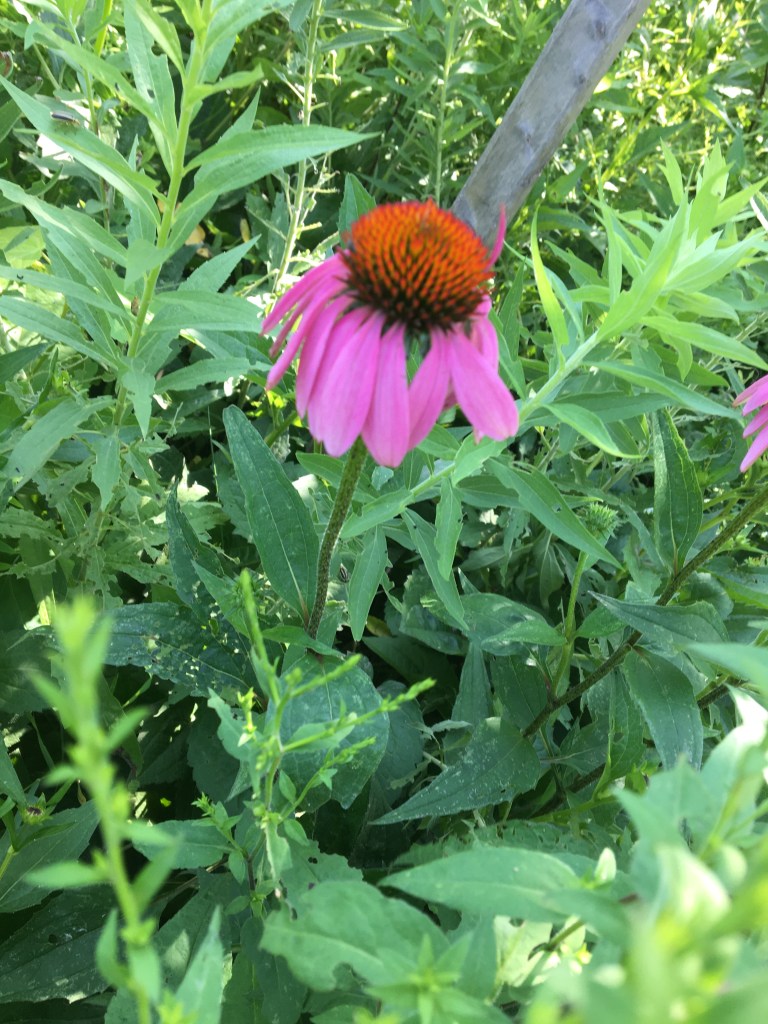
By that time, the federal funds had dried up, so after founding the Friends of Island Park and recruiting six other volunteers, Hecht coordinated a massive cut in 2017 to hack out the invasive species that had quickly overtaken the plot.
Parks: Hidden Gems with recent renovations
Walking past the bright thickets of starry black-eyed Susans and shuttlecock-shaped yellow and purple coneflowers, Hecht proudly pointed out the deep brown, sweeping strands of turkeyfoot grass. He sweeps his hand across the pink bursts of Joe-Pye weed and stoops to caress the bright fuschia Queen of the Prairie.
Some of these pollinators are already in bloom, but the ironweed and other milkweed varieties have yet to shoot out their brilliant colors. With broad, flat leaves low to the ground, most of the prairie dock is still shooting up its tall stem five to seven feet high, with a yellow flower just beginning to emerge.
The newly renovated bike and walking paths that are a part of Mayor Corey Mason’s larger initiative of expanding bicycle and pedestrian accessibility in Racine, connect the Root River Pathway and other hiking trails that stretch throughout Lincoln, Island and Colonial parks.
Dotting the walk are a few informational kiosks. Most of them are blank, but one in Lincoln Park posts notices about salmon and trout fishing regulations, while another identifies common plants, grasses and birds.
“The warblers really bring the birders out to Colonial Park,” Hecht says. And during the two salmon runs throughout the year, the popular fishing spots will leave the narrow roads packed with cars, but at other times of the year, like this mid-July Saturday, it feels lightly trafficked.
“I guess you could call them hidden gems,” he says.
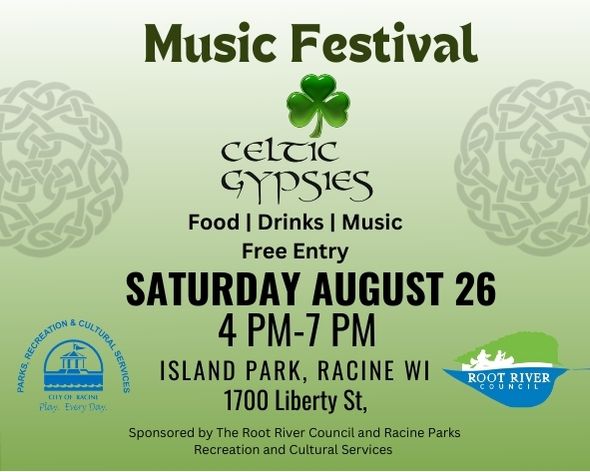
If you need another reason to see the garden plots for yourself, the Root River Council will hold a music festival at Island Park on Saturday, August 26, from 4-7pm, featuring the Celtic Gypsies.
Dealing with invasive species using controversial means
Walking with Hecht through the space as he wields a garden scythe, pointing out the various other invasive species — Queen Anne’s lace, creeping bellflower, thorny black locust — noting how many need to be cut back.
Hecht said a controlled burn could help to keep the invasive plants at bay.
“Normally you’d have a fire every two or three years,” he says. “But the city won’t go for it.”
Hecht applies a glyphosate solution early in the season in an effort to keep the invasive species. There’s still controversy publicly around whether to use glyphosate, the principle chemical in the Roundup product that got a bad name after multiple civil suits in which the owners of the chemicals.
Among those who fight weeds on a regular basis, opinion remains split, though what is clear is that glyphosate provides a safer alternative to more toxic herbicides.
News coverage since the mid 1990s has shown environmental groups and recent lawsuits allege that glyphosate is carcinogenic, pointing to the civil suits against Monsanto (now owned by Bayer) and to the World Health Organization’s finding in line with several studies that the chemical is “probably carcinogenic.”
At the same time, those who don’t oppose its use over other chemicals or household remedies, point out that other “probably carcinogenic” items listed by the WHO include red meat, working third-shift and burning wood indoors. They also note that the EPA has ruled glyphosate has low toxicity for humans and, within days after it’s been sprayed, no longer poses a threat to animals.
An educational endeavor on a shoestring budget
The bergamot or bee balm has just begun to blossom. When I ask him how much maintaining the gardens costsHecht takes a bud with some leaves and crushes it, releasing the oregano-like aroma, and he hands it to me.
“There’s technically no cost,” Hecht says, brushing off his own expenses. He mentions that he brings his own hedgers and trimmers in for volunteers to tend the garden.
Hecht’s educational spirit, evident in his background teaching high school equivalency or GED programs with community-based nonprofit organizations, extends to his efforts with FOIP.
In that spirit, Hecht has printed off informational sheets about the various native flowering plants. If you look closer, you’ll notice he’s pasted them to reused airline food trays, which he says he bought for five cents each.
The group not only works to preserve the land and maintain its use for the community, it also promotes the historical significance of the park. Few may realize, for instance, that Racine’s park system was designed by Danish immigrant Jens Jensen, a lauded landscape architect.
Hecht has also snow-seeded another 17 varieties of his own in the winter of 2021, by spending $300 of his own money and securing a matching donation. The saplings that have sprouted he and other volunteers marked with flags.
He also notes that in case of drought, the Friends of Island Park water the plots, which sit about 8 feet above the water table, by hauling water out in garbage cans and distribute it among the plants with buckets.
Responsible for growth
Pointing to a cluster of Joe-Pye weeds far from one of the original plots, Hecht says one piece of good news is that the stands of flowering perennials have spread, not just within their plots, during his time caring for the plots. They’ve also been seeded by animals and wind to other areas of the parks.
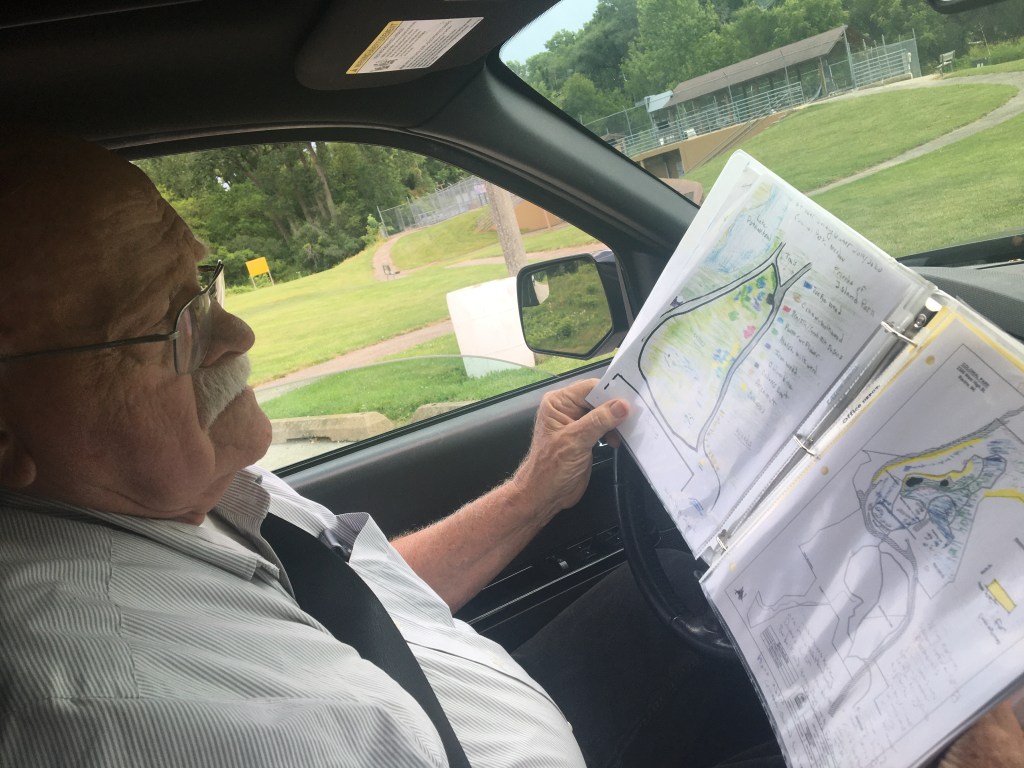
As we get into his black SUV to tour Lincoln and Colonial Park on a tight time frame, I ask Hecht what keeps him motivated to come back season after season, caring for the plants.
“I feel I have some responsibility to do it,” he says with a commonsense shrug. “It’s life.”
 ArtRoot Writer-In-Residence
Hey Nick,
Another great post. I want to go check out this place in my own city that I’ve never noticed. It was good to give Dave some credit for his labor of love.
Tom R
>
LikeLike
Thanks, Tom. I appreciate your kind words. A good walk off the beaten path through Island, Lincoln and Colonial parks would do a body good. Maybe we can meet up sometime for a stroll.
LikeLike
Nick,
I’m a regular walker always up for a new place to walk. Just let me know….
<
div>Tom
Sent from my iPhone
<
div dir=”ltr”>
<
blockquote type=”cite”>
LikeLike